
Key points
- Decide early whether you want a showroom piece or a made-to-order one, because that sets the timeline.
- Request physical samples of every fabric, leather and finish, and judge them at home.
- Measure the route into the house as carefully as the room itself.
- Ask for care instructions written for the exact materials you chose.
This guide is for anyone in Dubai planning to buy Italian sofas, dining tables, beds or cabinets for a villa or apartment, whether through a showroom, a designer or a direct order. It explains how the buying routes differ, what to verify before paying a deposit, and how to avoid the usual disappointments: a colour that looks wrong at home, a piece that will not fit through the door, or a finish that does not suit the climate.
Showroom piece or made to order
There are two basic routes, and the choice shapes everything that follows.
Showroom or stock pieces can be seen, sat on and often delivered sooner. What you see is usually what you get, which removes uncertainty about proportion and comfort. The trade-off is limited choice of size and finish, and the possibility that the display item is a sample that has been handled for some time.
Made-to-order pieces are built after you confirm the specification. You choose dimensions, fabric or leather, frame finish and sometimes details such as stitching or base. The piece arrives new, but you are committing to something you may only have seen in a catalogue or in a different colour in the showroom.
Many households combine both: stock items for rooms needed quickly and ordered pieces for the main living and reception spaces. If you are planning a whole house, read planning a villa interior in Dubai to place furniture purchases in the right order against construction.
Lead times, in general terms
Ordered pieces are built in Italy and then shipped, cleared and delivered, so the total wait is often longer than buyers expect. The exact time depends on the manufacturer, the collection, the season, the finish and the shipping method, and it can change between the quotation and the order. Do not rely on a figure quoted in conversation.
Ask the supplier to put in writing:
- The estimated production period and the estimated delivery window as separate items.
- What happens if the date slips, and whether you are told proactively.
- Whether production starts on deposit or only after you have signed the final specification.
- Whether the goods are stored until you are ready, and whether storage is free or charged.
Work backwards from the date you need the piece, and keep a buffer. Furniture should arrive after painting, flooring and lighting are finished, so a late building schedule can be as much of a problem as a late factory.
Samples of fabric, leather and finishes
Do not approve a material from a photograph alone. Screens shift colour, and images hide grain, weave and sheen.
What to request
- Fabric: a large swatch, not a small clip, ideally with the exact colour code written on it. Ask about cleaning code, rub resistance and whether the fabric is treated against stains.
- Leather: a sample of the specific hide type and colour. Ask whether it is pigmented or natural, because natural leather shows marks and variation more openly.
- Wood and veneer: a finish sample, with a note that individual boards or sheets vary by nature.
- Metal and stone: samples of the base, leg or top, as the finish can differ between brushed, polished and lacquered versions.
How to judge them
Take the samples home. Look at them next to your flooring, wall colour and curtains, in daylight and again under evening lighting. Dubai sunlight is strong, so check the sample near the window it will sit beside. Materials for the Gulf climate explains which fabrics and finishes need extra care in bright, dry or coastal conditions.
Keep the signed sample or a photograph of it with the order. If the delivered colour differs, it is your reference.
Measure properly
Measurements fail in two places: the room and the route.
In the room
Mark the footprint on the floor with masking tape and live with it for a day. Check that doors can open, that there is room to walk around a dining table with chairs pulled out, and that a sofa does not block an air-conditioning outlet or a wall socket you need. Confirm the piece's height against windowsills, curtains and any picture lighting.
Along the route
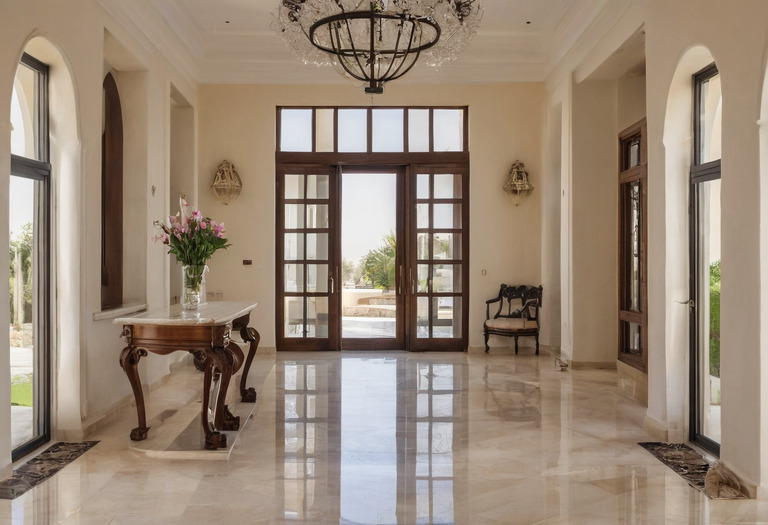
Measure the front door, internal doors, stairs, turns, lift cabin and corridor width. Note the height of ceilings on staircases and any low beams. In an apartment building, ask the management office about lift booking, protection rules and permitted delivery hours. Requirements vary by building, so check rather than assume.
Ask the supplier for the packed dimensions, not only the finished size. Some large sofas come in sections; others cannot be separated, and a balcony hoist or window access may be the only route.
Delivery, installation and access
Clarify who handles each step: unloading, carrying, unpacking, assembly, positioning and removal of packaging. Ask whether the delivery team inspects the piece with you and whether you can note damage on the delivery document before they leave.
Before delivery day:
- Finish all dusty and wet work in the house.
- Protect floors along the route.
- Confirm lift booking and building access if you live in an apartment.
- Make sure someone who can make decisions is present to approve positions.
Inspect each piece as it is unpacked: frame, stitching, finish, hardware, dimensions against the order. Photograph any fault at once and report it in writing the same day. Keep the packaging until you are satisfied.
Care in the Gulf climate
Italian furniture is well made, but Dubai's conditions are demanding. Strong sunlight can fade fabrics and dry leather. Air conditioning lowers humidity indoors, which can stress solid timber and veneers. Fine dust settles quickly on dark lacquer and glass.
Practical habits help:
- Keep upholstery and timber away from direct sun, or use curtains and window film suitable for the glazing.
- Keep leather away from air-conditioning outlets and clean it with the product the maker recommends.
- Dust lacquered and polished surfaces with a soft cloth rather than a dry, gritty one.
- Use coasters and protect stone tops from acids and oils.
- Follow written instructions for each material. If none come with the piece, ask for them.
For spaces used for large gatherings, such as a reception room, choose surfaces that tolerate heavy use. The considerations in modern majlis design apply to any room where many guests sit.
Next steps
Collect quotations that list specification, dimensions, finish codes, delivery terms and storage in the same format, so they can be compared directly. Then read materials for the Gulf climate to check that the fabrics and finishes you favour will age well in your home.